Moonchild AI Pricing: What You Get at Each Tier
Updated March 10, 2026

Moonchild AI is a design generation tool that turns product requirements into structured UI layouts. Instead of manually designing every screen from scratch, you provide a prompt or paste a PRD, and Moonchild generates complete interface screens that follow your specifications.
A single generation typically produces multiple layout directions for the same feature, allowing teams to quickly compare approaches and select the strongest one before refining it in Figma.
Moonchild offers a free tier plus several paid tiers, with pricing structured around monthly generation credits. The free tier lets you try the tool and understand how it works with your design system. Paid tiers unlock more capacity and features.
Free Tier
Free Tier includes up to 43,000 credits per month. Each generation can produce multiple screen options, so you get real utility from the free tier. You can create a design system, generate screens, and export to Figma for review. The free tier is legitimate for testing and for solo designers or PMs who generate occasionally.
Professional Tier
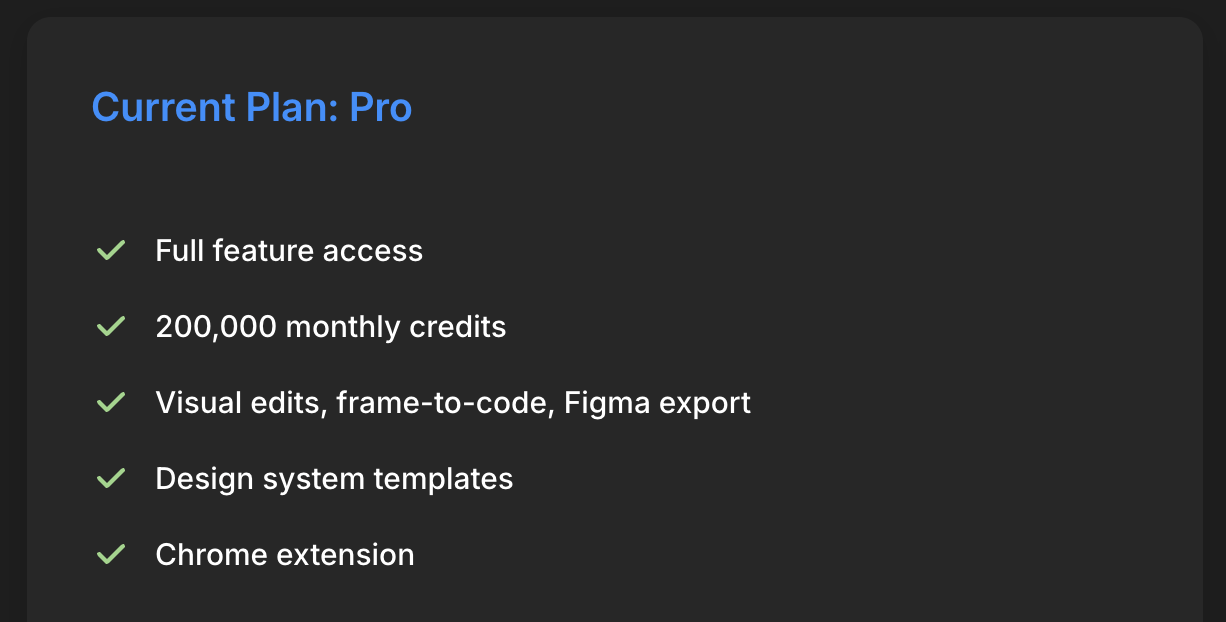
Professional Tier (representative mid-level) includes 200,000 monthly credits, design system templates, and the ability to export to all destinations (Figma, Figma Make, Cursor, Claude Code, Bolt, Lovable). This is right-sized for a small product team.
A typical feature with 2-3 design iterations uses 3-4 generations. At 200,000 credits per month, you have room for multiple features plus iteration, just for $12 per month. Cost is roughly equivalent to a few hours of design time per month.
Max Tier
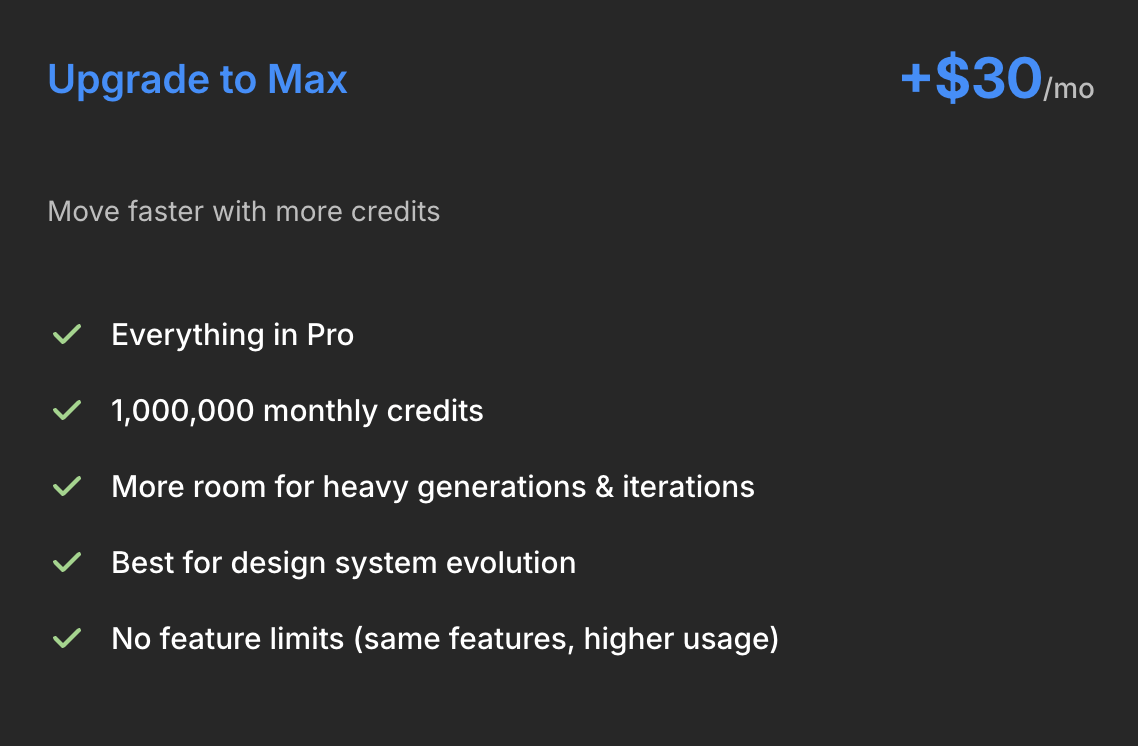
Max Tier includes everything in Pro, 1,000,000 credits per month, no feature limits, etc. This is accessible for $42 per month.
Team Tier
Team Tier includes unlimited generations, dedicated support, advanced team features, API access, and custom integrations. Pricing is custom based on your usage and needs. This is for larger organizations where design generation is a core part of the workflow.
Pricing Comparison Table
| Tier | Monthly Credits | Pricing per month | Features | Best For |
|---|---|---|---|---|
| Free | 43,000 | $0 | Single user | Individual testing, solo designers, occasional use |
| Professional | 200,000 | $12 | Basic (single workspace) | More professional usage, used consistently |
| Max | 1,000,000 | $42 | Collaboration, commenting, version history | Small product people, early-stage startups |
| Team | Custom | Custom | Dedicated support, advanced features | Multi-person teams, multiple PMs and designers |
Conclusion
Moonchild's pricing is built around how teams actually design products. Most teams go through cycles of exploration, iteration, and refinement. The free tier gives individuals enough room to understand the workflow and see how the tool fits into their process.
As teams start using Moonchild more regularly, the paid tiers provide the extra generation capacity and collaboration features needed to support ongoing product work.
The real value of Moonchild is not only in the number of generations you receive each month. It is in the time saved between product requirements and the first structured UI layouts.
Instead of spending hours translating specifications into initial screens, teams can quickly generate directions and move straight to reviewing and refining the design. This allows designers to focus more on improving the user experience and the quality of the final product.
Written by
Lotanna NwoseSenior PMM with 7 years experience across multiple teams. Building the new way of using AI to do Product Design work at Moonchild AI.
Related Articles
How AI Changes Early-Stage Product Prototyping
AI changes the product discovery equation by making visualization cheap and instant. Teams can now generate visual prototypes at the same moment they're writing requirements, shifting discovery from conversation to visual exploration.
How to Build an AI Design Tool Stack That Actually Works
Most teams use too many AI design tools or the wrong combination. Learn how to build a focused tool stack that covers ideation, generation, refinement, and handoff without redundancy.
8 Best Rapid Prototyping Tools for Product Teams in 2026
Compare the 8 best rapid prototyping tools for product teams in 2026. From AI-first platforms like Moonchild AI to high-fidelity interaction tools like ProtoPie, find the right fit for your workflow.